



Blade Trimmers Bruise Flower & Strip Trichomes Explained
Jul 15th 2026
Blade Trimmers Bruise Flower and Strip Off Trichomes.
For years, the cannabis industry accepted a simple tradeoff:
If you wanted speed, you used a machine.
If you wanted quality, you hand trimmed.
Most growers believed there was no way around it.
I know because I was one of them.
When I first started looking at trimming equipment, I wasn’t trying to reinvent the process. I wasn’t trying to create a bladeless trimmer. In fact, I spent years trying to improve blade trimmers.
Like everyone else, I assumed the answer was a better blade.
A sharper blade.
A different blade angle.
A different speed.
A different drum design.
A different cutting mechanism.
I built prototypes. I tested ideas. I made modifications.
And no matter what I did, I kept running into the same problem.
The flower was being damaged.
The Problem Was Never the Machine
At first, I blamed the design.
Then I blamed the settings.
Then I blamed the operator.
Eventually, I realized something important.
The problem wasn’t the machine.
The problem was the blade itself.
A blade doesn’t know the difference between a sugar leaf and a trichome-covered calyx.
Its job is simple: cut whatever touches it.
Every time flower passes over a blade, some amount of plant material is removed. Unfortunately, that often includes trichomes and parts of the flower growers are trying to preserve.
The faster the machine runs, the more aggressive the process becomes.
The result is a tradeoff growers have accepted for decades:
More speed, less quality.
I started asking a different question.
What if the blade wasn’t part of the solution?
What if the blade was the problem?
The Day Everything Changed
One day I stopped trying to improve blade trimmers.
Instead, I asked myself a completely different question:
Could flower trim itself?
It sounds crazy, but the more I thought about it, the more it made sense.
If properly dried flowers could gently interact with one another in a controlled environment, perhaps the excess leaf material could separate naturally without a blade ever touching the flower.
That idea led me to develop a completely different approach.
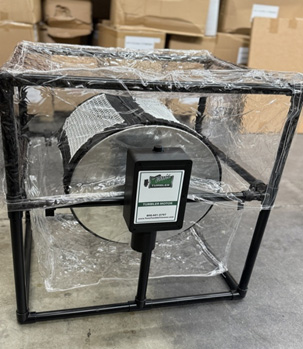
Instead of a small metal drum with blades, I created a much larger diameter trommel.
Instead of metal contact surfaces, I used a soft mesh.
Instead of cutting the flower, I allowed the flowers to gently tumble against one another.
What I Learned
The breakthrough wasn’t the machine.
The breakthrough was understanding the process.
I quickly learned that three things were critical:
First, the flower had to be dried correctly.
Second, the correct amount of flower had to be loaded into the chamber.
Third, the tumbling process had to be slow and controlled.
When those conditions were met, something remarkable happened.
The flowers essentially trimmed themselves.
The excess leaf material separated naturally.
The flower wasn’t being cut.
It wasn’t being chopped.
It wasn’t being beaten against blades.
It was simply being allowed to move and interact in a controlled environment.
The result was cleaner flower with dramatically less damage.
More importantly, the trichomes stayed where they belonged—on the flower.
The Importance of Trichomes
Every grower understands the value of trichomes.
They contain the cannabinoids.
They contain the terpenes.
They contain much of what gives premium flower its aroma, appearance, potency, and value.
Yet traditional trimming equipment often treats trichomes as collateral damage.
I wanted a process that preserved them.
When we compared our results to conventional blade trimming, the difference was obvious.
The flowers maintained their appearance.
The trichomes remained intact.
The buds looked more natural.
And after a quick hand touch-up to remove the remaining crow’s feet, many growers could not distinguish the flower from hand-trimmed product.
That became the standard we chased from that point forward.
Not machine-trim quality.
Hand-trim quality.
Why We Never Went Back
Since developing the first bladeless trimming systems, we’ve sold thousands of machines around the world.
The equipment has evolved.
Production capacity has increased.
Features have improved.
But the core principle has never changed.
The flower should not be attacked.
The flower should be respected.
Instead of forcing a blade through delicate plant material, we allow physics and proper drying to do the work.
The result is a gentler process that helps preserve the characteristics growers worked so hard to produce.
The Bottom Line
I’ve spent years around trimming equipment.
I’ve built blade machines.
I’ve tested blade machines.
I’ve modified blade machines.
And after all of that, I came to a simple conclusion:
The blade was never the answer.
For me, the goal has always been simple:
Preserve the flower.
Protect the trichomes.
Maintain quality.
That’s why we built a different kind of trimming machine.
One that doesn’t rely on blades.
One that doesn’t treat quality as a compromise.
Because at the end of the day, blades bruise flower and cut off trichomes.
We don’t.