




From Garage to Global: The Story Behind Tom's Tumble Trimmer
Apr 16th 2026
I Built the First One in My Garage
Every successful product has a story.
Mine started in a garage.
Not with investors.
Not with engineers.
Not with a business plan.
It started with a problem.
I was a grower, and like every grower, I wanted my flower to look as good coming out of the trimming process as it did going into it.
The problem was that every machine I tried seemed to do the same thing.
It damaged the flower.
Looking for a Better Way
Back then, blade trimmers dominated the market.
Manufacturers competed by making blades faster, sharper, and more aggressive.
The industry seemed focused on one thing:
Speed.
The problem was that speed often came at the expense of quality.
As I watched flowers pass through machine after machine, I kept seeing the same issues.
Bruised flower.
Lost trichomes.
Reduced bag appeal.
The flower coming out simply didn’t look like the flower that went in.
As a grower, that bothered me.
Because I knew how much work it took to produce great flower in the first place.
Months of cultivation could be undone in minutes during trimming.
I Tried Everything
Like most inventors, I didn’t start by trying to create something completely new.
I started by trying to improve what already existed.
I experimented with different approaches.
Different machines.
Different settings.
Different concepts.
I kept looking for a blade system that would preserve quality.
I never found one.
The more I worked with blade trimmers, the more obvious the problem became.
The issue wasn’t the operator.
The issue wasn’t the settings.
The issue wasn’t even the machine.
The issue was the blade itself.
A blade cuts.
That’s what it’s designed to do
Unfortunately, flowers don’t care whether they’re being cut by a lawn mower or a trimming machine.
The result is still damage.
That’s when I started asking a different question.
What if the blade was the problem?
The Idea That Changed Everything
At some point, I stopped trying to improve blades.
Instead, I removed them.
Completely.
That decision changed everything.
What if flowers could be trimmed without cutting them?
What if properly dried flowers could gently interact with each other and naturally remove excess leaf material?
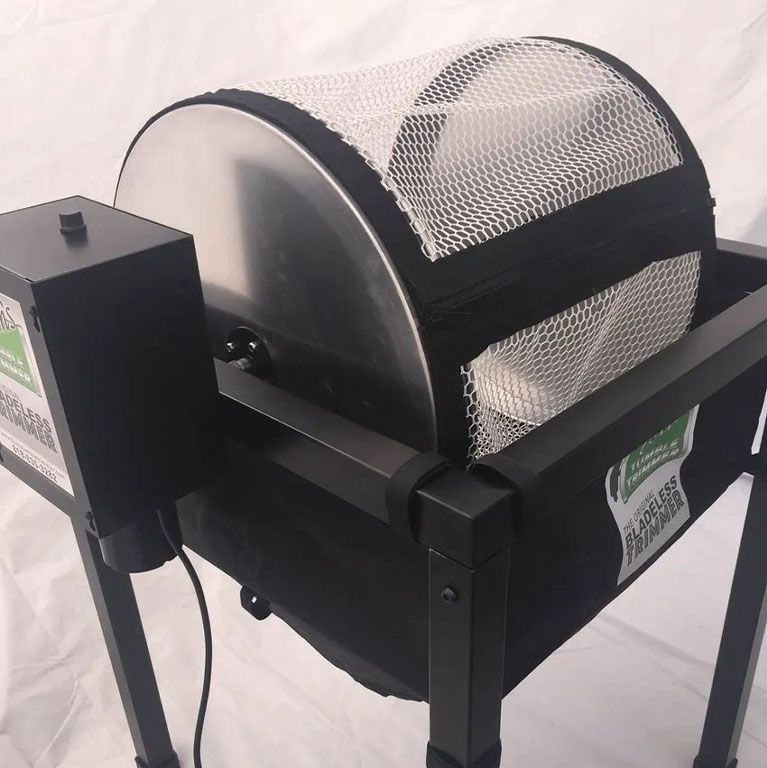
That idea became the foundation for what would eventually become the Tom’s Tumble Trimmer.
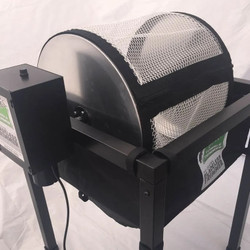
Instead of relying on blades, I developed a large-diameter tumbling chamber that used a soft mesh surface.
The concept was simple.
When properly dried flower is loaded correctly and gently tumbled, the flowers naturally work against each other.
The excess leaf material separates.
The flower stays intact.
The trichomes remain where they belong.
And the results are dramatically different.
The Garage Years
The first machines weren’t built in a factory.
They were built in my garage.
Every improvement came from testing.
Every adjustment came from trial and error.
Every lesson came from working directly with the flower.
There were plenty of late nights.
Plenty of failures.
Plenty of moments when it would’ve been easier to quit.
But every time I saw flower come out looking better than it did with a blade machine, I knew I was onto something.
The concept worked.
The challenge was turning it into a business.
The First Sales
Once I had a machine that consistently produced the results I wanted, I filed a provisional patent.
Then I started selling them.
Not through distributors.
Not through dealers.
Through eBay.
One machine at a time.
The early customers were taking a chance on a completely different idea.
A trimming machine with no blades.
At the time, that sounded crazy to a lot of people.
But once growers saw the results, they understood the difference.
Word started spreading.
More growers bought machines.
More growers told other growers.
And the company slowly began to grow.
Thousands Later
Since those early garage days, tens of thousands of machines have been sold around the world.
The company has grown.
The product line has expanded.
The industry has changed.
But something interesting happened along the way.
The core chamber design never really changed.
Why?
Because it worked.
The principle that made the first machine successful is the same principle that drives our machines today.
Properly dried flower.
Gentle tumbling.
No blades.
Preserve quality.
It’s still that simple.
Some Things Don’t Need Fixing
People often ask me what I’d change about the original concept.
The answer is very little.
We’ve improved manufacturing.
We’ve added options.
We’ve expanded capacity.
We’ve introduced new products.
But the core idea remains exactly the same as it was when I built the first machine in my garage.
Because sometimes innovation isn’t about adding something.
Sometimes it’s about removing something.
In my case, it was the blades.
And looking back, that simple decision changed everything.
Some things don’t need fixing.